The Moment Everything Shifted
On January 20, 2025, a Chinese AI lab called DeepSeek released a model called R1. It performed at roughly the same level as OpenAI’s o1 model. The training cost was under $6 million. Let that sink in. OpenAI’s comparable model cost somewhere north of $100 million to train. We’re talking about a 95% cost reduction for equivalent capability.

That same week, NVIDIA lost $600 billion in market value in a single trading day. That’s not a typo. The stock dropped 17% because the market instantly understood what DeepSeek’s achievement meant: the cost structure for building frontier AI just got demolished. Everything your CFO had been planning around, everything Wall Street priced in, became obsolete in an afternoon.
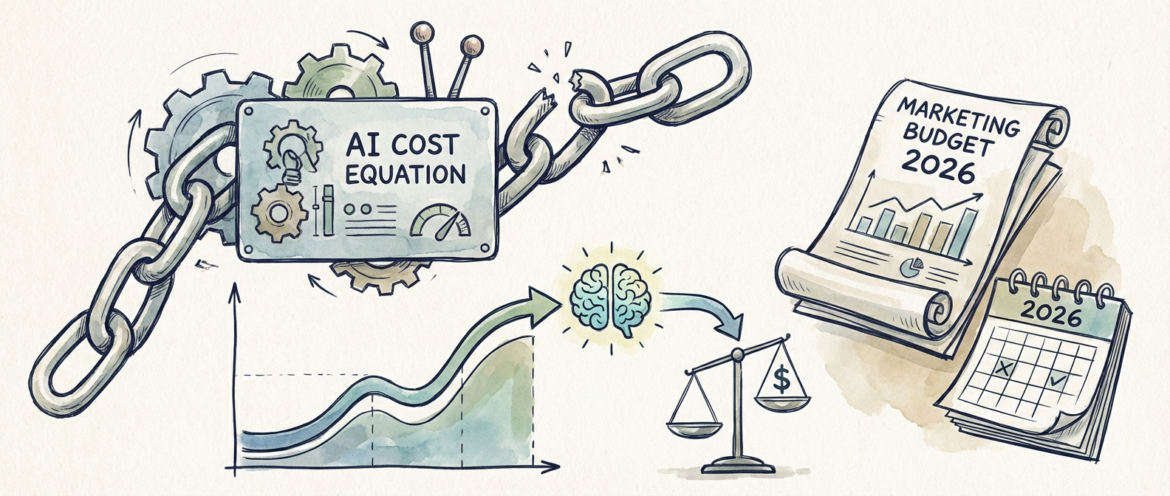
This wasn’t a marginal improvement. This was a structural break in the industry. And if you’re managing a marketing budget in 2026, you need to understand exactly what this means for you.

The Pricing Collapse Is Real
Here’s where most analyses go fuzzy. They talk about “price wars” and “competitive pressure” like this is some cyclical market dynamic. That’s wrong. What happened after DeepSeek wasn’t a pricing negotiation. It was a repricing based on fundamentally different economics.
Between January and December 2025, API pricing for frontier-class AI models dropped an average of 60 to 70% across major providers. Not 10% or 20%. Sixty to seventy percent. Your token costs for GPT-4-class models are now a fraction of what they were at the end of 2024. The providers didn’t want to cut prices this aggressively. They had to. DeepSeek made it impossible to justify the old price structure.
Think about what that does to your unit economics. If you were running AI-powered content generation or customer service automation at the old prices, your cost per output just dropped by two-thirds. That’s not a nice-to-have optimization. That’s a game-state change.
Your Competitors Already Know This
According to the HubSpot 2026 State of Marketing Report, 74% of marketing teams now use AI tools for content generation. That’s up from 48% just two years earlier. The top driver? Cost reduction.
This isn’t aspirational. This is what’s actually happening. Three out of four marketing teams have already restructured their content workflows around AI. Most of them moved faster than you probably did. They did it because the economics finally worked. And now that the cost structure has shifted again, they’re not sitting still.
The teams that waited for prices to drop, that built business cases around future AI cost projections, are already executing. The ones that rationalized holding back because AI was “too expensive” in 2024? They’re now behind on both adoption and capability.
What This Actually Enables for Your Campaigns
When AI inference costs drop by 70%, you stop treating AI as a luxury input for premium use cases. It becomes your baseline operating cost. That changes what’s possible.
Forrester Research ran the numbers in early 2026 and projected that mid-market B2B companies implementing AI-driven personalization correctly could reduce customer acquisition costs by 25 to 35% within 12 months. Not through some magical product innovation. Through better targeting, smarter segmentation, and real-time content adaptation. All of it powered by models that now cost almost nothing to run.
Real personalization at scale used to require either a massive data science team or budget you didn’t have. Now? The math works. You can dynamically generate variations of landing pages, email sequences, and ad copy based on buyer signals. You can test hypotheses faster because failure is cheap. You can run 100 variations instead of five because running 100 now costs less than running five did two years ago.
The constraint isn’t economics anymore. It’s execution capability and organizational courage.
What You Should Actually Do Now
First, audit what you’re spending on AI tools and services right now. Not what you budgeted. What you’re actually spending. If you’re paying 2024 prices for 2026 work, you’re leaving money on the table.
Second, look at the DeepSeek-R1 technical report if you want the technical depth, but the practical takeaway is simpler: the cost floor for capable AI inference just got incredibly low. That means you can afford to be more experimental. You can afford to personalize more aggressively. You can afford to test ideas that seemed marginal at the old price point.
Third, don’t treat this as a one-time adjustment. The cost structure will probably continue to improve, but at a slower pace than we just saw. Plan for that. Build models that account for AI as a commodity input, not a specialty item.
The real risk isn’t that you adopt AI too aggressively in 2026. The real risk is that you adopt it too conservatively. You’ve got a window to build capabilities and processes that your competitors are also building. First-mover advantage in AI-enabled personalization doesn’t last forever, but it lasts long enough to matter.
What’s your current blocker to moving faster on AI adoption? Budget? Execution capability? Technical knowledge gaps? I’d genuinely like to hear what you’re seeing in your organization, because the patterns emerging across different industries are worth documenting.