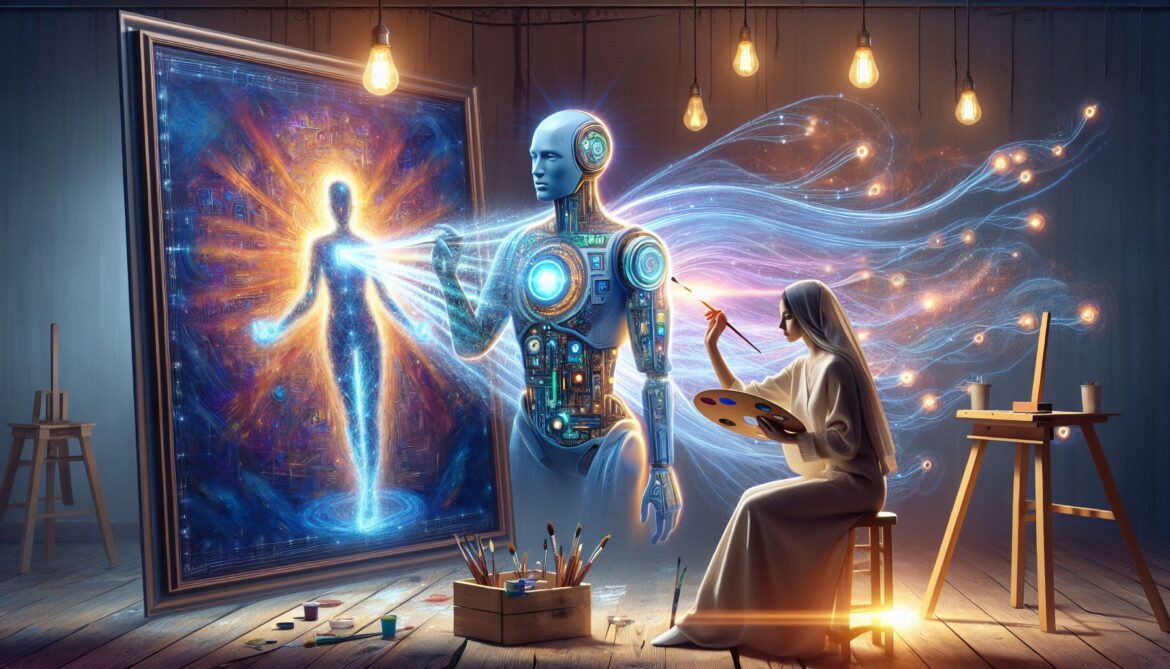
Hey tech enthusiasts! Today, let’s talk about something I’ve been obsessing over lately: Artificial Intelligence in the creative arts. Yeah, I know what you’re thinking—can a bunch of lines of code truly capture the magic of human creativity? The short answer is “heck, yes!” So, grab some coffee, settle in, and let’s explore how AI is completely changing creative fields.
Where AI Meets Art: A Colorful Collision
Let’s start at the beginning: how did AI even get into art? Well, artists and techies alike have been fascinated by this intersection for years. I was thinking the other day about the first time I stumbled upon Google’s DeepDream images. Remember that psychedelic kaleidoscope of wild colors and dreamlike patterns? It was like entering a Salvador Dalí painting! This was one of the first signs that AI could do more than just number crunching; it could dream, or at least help us humans dream differently.
Today’s AI has come so far from those trippy beginnings. Thanks to advanced neural networks, computers are now painting, sketching, writing poetry, and even composing symphonies. It’s like having an extra set of hyper-talented hands. And what’s even more exciting? These AI-driven creations aren’t just neat experiments anymore. They’re actually making it into galleries and mainstream media.
The Rise of AI Brushes and Pens
Remember the time before we had spell check? We’d type out documents or (really showing my age here) handwrite them, then painstakingly look for misspellings. Fast forward to today, and we’ve got AI helping not only with proofreading but generating entire chunks of content. That’s right: AI is now crafting marketing copy, short stories, and even books!
Take GPT-3 for instance. Developed by OpenAI, it’s basically a creative powerhouse, capable of generating eerily human-like text. I once asked it to whip up a story about a spacefaring Corgi, and let me tell you, it was an instant classic among dog and sci-fi lovers alike.
And let’s not forget visual arts! AI can now help artists design complex patterns, create incredible visuals, or even replicate the styles of classical painters. Tools like DeepArt or style transfer technology allow anyone to channel their inner Van Gogh (minus the whole ear incident).
AI: The Symphony Maestro
Now, let’s talk music. AI isn’t just limited to visual and textual arts. At the crossroads of AI and music, we’ve got Amadeus Code, which works like an algorithmic muse, helping composers overcome writer’s block. The idea isn’t to replace musicians but to enhance their creativity, acting as a bridge for those small leaps between inspiration and realization.
For instance, have you listened to the Beatles-inspired song generated by OpenAI’s Jukebox? Sure, it’s not chart-topping material (yet), but it’s a fascinating glimpse of a not-too-distant future when AI-generated music might be just as emotionally resonant as traditional compositions.
Painting the Ethical Landscape
No rosy picture would be complete without some darker hues. As we weave AI more deeply into the fabric of creativity, a series of ethical questions pop up: Who truly owns AI-generated art? If a neural network paints a masterpiece, does the credit go to the algorithm’s developer, the user, or the machine itself?
There are economic aspects to consider as well. Could AI potentially water down the job market, replacing human creators with cost-effective algorithms? Maybe, though personally, I like to think human ingenuity will always find new ways to thrive. We’re pretty good at adapting.
A Canvas for the Future
Looking ahead, I can totally see AI becoming even more intertwined with art, empowering creators to push boundaries like never before. Imagine interactive installations that respond in real-time to audience emotions or virtual novels that adapt based on each reader’s mood.
In my ideal techno-utopian future, AI-driven creativity doesn’t threaten human artistry. Instead, it works as a catalyst for a renaissance of new ideas, perspectives, and innovations. It’s about augmenting, not replacing human creativity.
So, let’s embrace this brave new world where art and AI coexist. Let’s paint it with bold strokes of imagination and innovation, all while enjoying the wonders that emerge when silicon brains get a taste of human creativity.
Keep creating, keep imagining, and, most importantly, keep being you—someone who knows that the future of the arts isn’t just human or machine but a beautiful blend of both. Until next time, let your ideas soar!