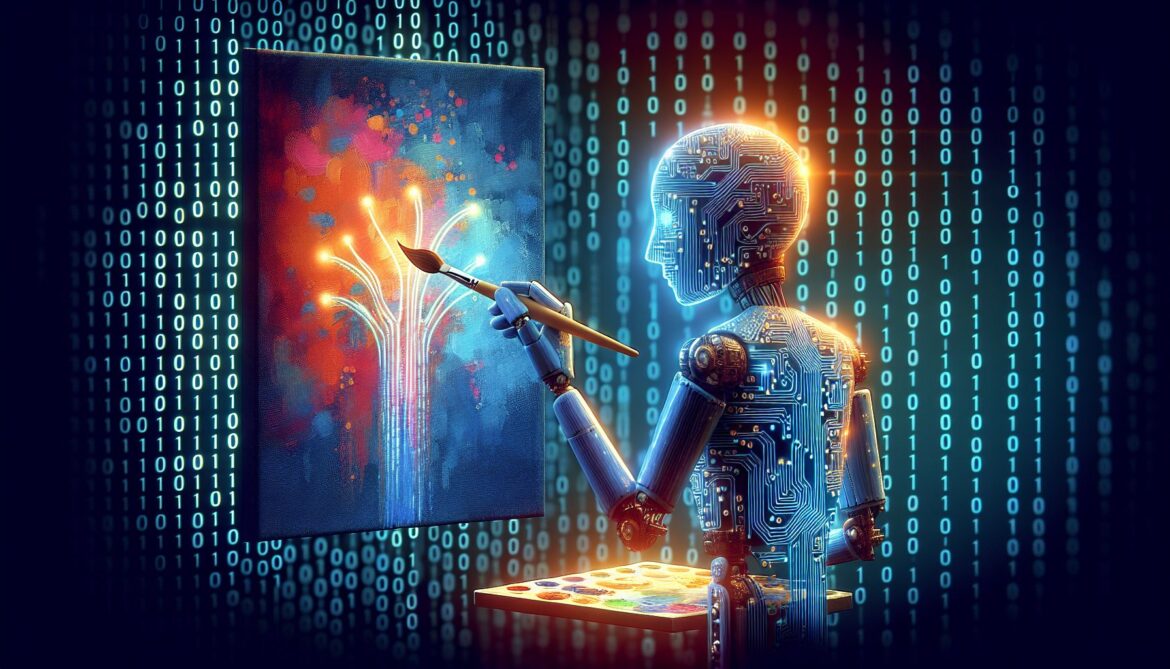
Alright folks, buckle up because today we’re diving into the deliciously mind-bending world where art meets artificial intelligence. Ever thought a robot could out-paint Picasso? Or perhaps write a novel that puts Tolstoy to shame? Well, I did—sort of. Years ago, while traipsing through the cacophony of tech expos and TED Talks, I stumbled upon an unassuming AI-powered art booth. This thing was painting sunsets on canvases that could make you cry. Fast forward to today, and AI’s creative abilities aren’t just a novelty act—they’re a full-blown revolution.
The Rise of the Machine Michelangelos
So, how did we get here, where AI can legitimately hold a brush (metaphorically) to Da Vinci? Let’s sketch out the history first. AI creativity runs on deep learning and neural networks, where systems gobble up data and spit out something surprisingly original. Projects like DeepDream and OpenAI’s DALL-E dropped jaws by remixing the digital and painted worlds. The first time I saw DALL-E’s imagery, my jaw actually hit the floor. Picture a landscape that looks like Van Gogh and Escher had a lovechild—yeah, it was that weirdly awesome.
What we’re seeing now is not just computers mimicking what humans do, but generating art that begs the age-old question, “What is art?” Today, an AI could conquer a canvas, perform a symphony, or produce a film script that’d earn a standing O at Sundance. Some purists argue it’s not authentic, but hey, the Renaissance dudes were once frowned upon for breaking away from medieval standards too.
AI’s Juicy Brain and How It Works
For anyone wondering, “How does a mindless computer know what creativity is, anyway?”—great question! AI creativity springs from a cocktail of algorithms which might just be nerd-talk for magic. These programs train on vast amounts of data—be it paintings, musical compositions, or epic novels. They ingest, interpret, and boom! They produce something entirely new.
Machine learning models, specifically GANs (Generative Adversarial Networks), are huge here. Imagine a frenetic ping-pong game where two AI models—the creator and the evaluator—pit their wits against each other. The creator AI tries to produce something realistic, while the evaluator AI judges its performance. This digital volley continues until the creation is so compellingly human that even a seasoned art critic might be stumped.
Implications and the Future of Creative AI
Now, we can’t talk about AI in arts without addressing the ripples across various industries. Will AI-generated content create a job apocalypse? Well, not exactly. Take a chill pill, because what we’re witnessing is more evolution than annihilation. Artists using AI is like photographers embracing Photoshop. The technology empowers human creativity rather than snuffing it out.
And it’s not just traditional art domains we’re talking about. Even the ad industry is jumping on the AI creative bandwagon. Personalized marketing campaigns sculpted by AI are making ads more engaging and less like digital noise. Plus, the democratization of art by AI could let every Average Joe compose a symphony or write a bestseller. Imagine a world where we all moonlight as creative geniuses—wait, that’s just my utopia speaking.
Challenges on the Path of AI Creativity
But folks, it’s not all rainbows and unicorns. The path to AI artistry has serious potholes. There’s the massive challenge of data bias—the machines can inadvertently reflect human prejudices lurking in their training data. I mean, tell an AI that a surreal painting needs a blue-haired protagonist, and it might churn out Caucasian figures disproportionately more often. Tackling these ethical problems will require both smart coding and serious foresight.
Moreover, the legalities surrounding AI-generated art are murky. Who holds the rights to a painting created by code? The programmer, the AI, or society at large? Until the lawmakers catch up, expect heaps of heated debates.
Wrapping It Up—The Art Revolution is Digital
So, where do I stand in all this? If I’m being honest (and occasionally romantic), I’d say we’re standing on the shoulders of giants. The old masters created the frameworks and now we’re layering on a digital dimension they couldn’t dream of. AI as an artistic partner—yeah, that’s something I can get behind. Whether it’s composing a new genre of symphonic metal or crafting a holographic installation for the next Burning Man, the union of silicon and creativity is just beginning to unravel its mysteries.
Next time you’re strolling through a gallery or tapping into a Spotify playlist, remember that the artist might not just be flesh and bones—but circuits and semiconductors too. Remember, in this brave new world of art, the only limit is imagination—and we’ve just handed that over to machines! Talk about giving creativity a serious upgrade, huh?