
The Cliff Nobody Wanted to See
Let me cut straight to it: the organic search traffic cliff is real, and it’s steeper than anything we’ve seen in over a decade. The HubSpot State of Marketing 2025 report landed last month with a number that should have every content marketer and SEO leader sitting up straight. B2B companies relying on inbound search traffic saw organic visits drop an average of 27% year-over-year. That’s not a market correction. That’s not a seasonal dip. That’s the steepest single-year decline HubSpot has measured since they started tracking this metric in 2012.

If you’re thinking “maybe it’s just my vertical,” stop. The pattern is industry-wide. And the culprit isn’t algorithm noise or link penalty spillover. It’s Google’s AI Overviews, and the shift they’ve created toward zero-click search results.
The Zero-Click Problem Is Bigger Than You Think
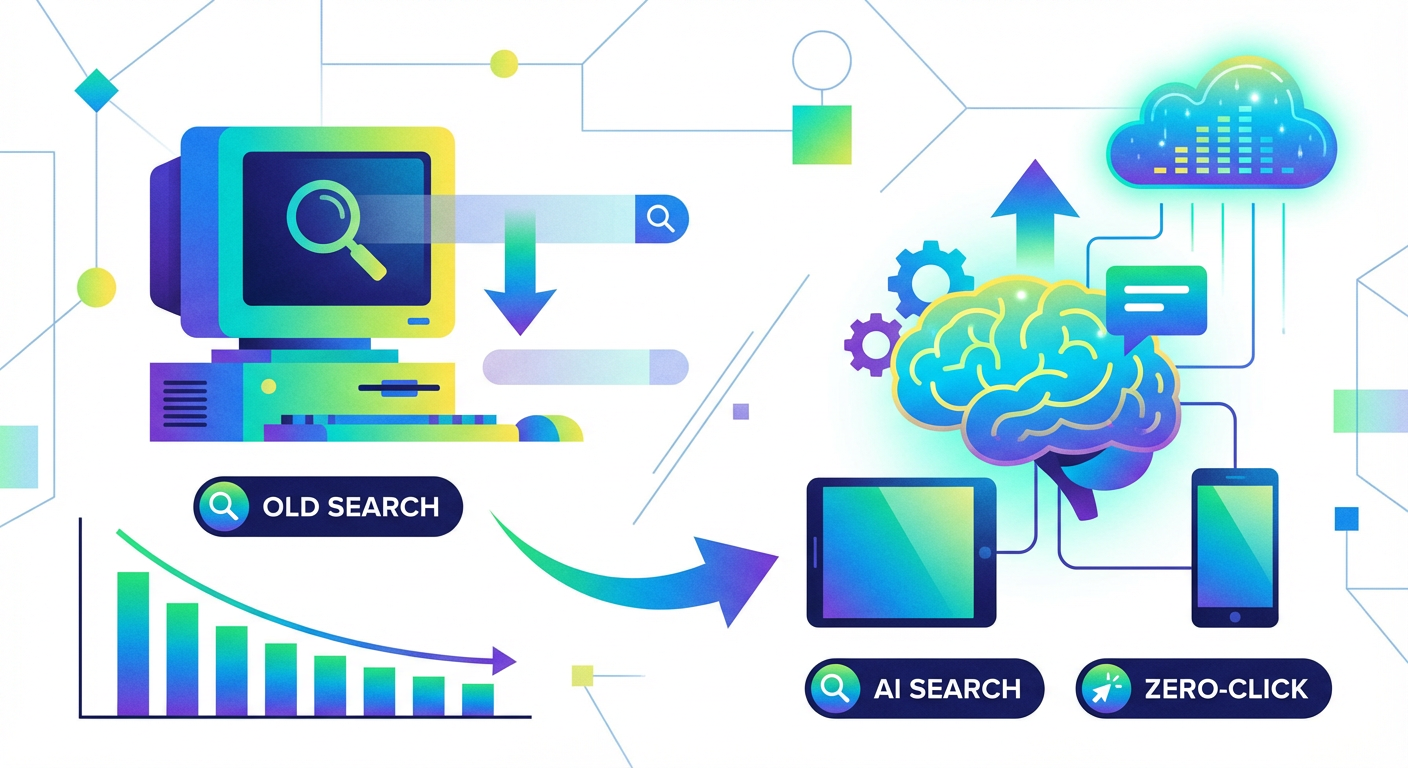
Here’s where the data gets uncomfortable. Research from mid-2024 showed that 58.5% of US Google searches already ended without a user clicking through to any website. By Q4 2025, that number had climbed to approximately 65%. Think about that for a second. Two out of every three searches now terminate at Google without ever sending a visitor to a destination domain.
Why the acceleration? Google’s AI Overviews went from a limited test to full US rollout starting in May 2024. By Q1 2025, BrightEdge data showed these AI-generated answer boxes were appearing in roughly 47% of informational and commercial-intent queries. That’s not edge-case territory anymore. That’s mainstream search behavior. Google is now answering user questions directly, pulling from multiple sources and presenting it as a neat package at the top of the SERP. Your content fuels the answer. Someone else gets the click.
The SparkToro Zero-Click Search Study corroborated this trend across different search types and user behaviors. What matters is the trajectory. We’re not talking about a small percentage of queries anymore. Zero-click is now the dominant search outcome.
What Gartner Told Us to Expect
Back in July 2024, Gartner published a prediction that seemed bold at the time. They forecast that traditional search engine volume would decline by 25% by 2026 as AI-powered alternatives and zero-click results absorb query intent. We’re essentially tracking right to that prediction. The combination of Google’s AI Overviews, ChatGPT’s continued adoption, and the emergence of alternative search models like Perplexity is fragmenting the search query pie.
This isn’t a hypothetical anymore. We’re living in it. The question for your marketing team isn’t whether this will happen. The question is how quickly it will happen in your specific market and how you’re going to adapt before your competitors do.
Not All Content Gets Hit Equally
Here’s where the data gets interesting, and where I need to push back against doom-and-gloom narratives. Semrush’s January 2026 industry analysis found that not every domain suffered equally. Sites with strong topical authority and authentic first-hand experience signals saw only a 9% traffic decline over the same period where thin aggregator and content farm sites dropped 34%. That’s a 25-point spread.
What does this tell us? Google’s systems are rewarding depth, specificity, and original insight. If you’re a software company writing about your own product, you’re winning. If you’re a consultant sharing hard-won expertise, you’re winning. If you’re a publication running listicles aggregated from five other sources, you’re getting demolished.
Zero-click search punishes commodity content. It rewards the unique, the authoritative, the original. This isn’t a reason to panic. It’s a reason to get strategic about what you’re actually creating.
What You Do Now Matters More Than What You Did
The analytics on your dashboard right now tell you what happened. They don’t tell you what’s coming. If you’re still measuring success purely through organic click-through traffic, you’re using a rearview mirror. You need to shift your north star.
Start here: which of your content pieces are appearing in AI Overviews? Check Google Search Console for impressions versus clicks. A piece getting 5,000 impressions but 200 clicks is functioning as a feeder for Google’s AI, not as a traffic driver for your business. Is that valuable? Sometimes. If you’re a B2B SaaS company, brand awareness and thought leadership still matter. But it’s different ROI. You need to know which is which.
Second: audit your content library against the E-E-A-T framework that actually moves the needle now. Experience, Expertise, Authoritativeness, and Trustworthiness. Can you prove each one? Generic advice pieces that could be written by anyone won’t cut it. Content that shows you’ve actually done the work, survived the mistakes, and learned the hard lessons will.
Third: stop treating search as your only channel. The zero-click world is making direct audience relationships more valuable than they’ve been in a decade. Email, communities, and proprietary tools are becoming your real advantage against the algorithmic winds.
The numbers tell us something changed. The question is whether you’re going to be reactive or proactive about it. What’s your current traffic trend looking like, and what changes have you already tested?